If you’ve ever set your phone on a wireless charger at the end of the night, whether at your desk, nightstand, or kitchen counter, you’ve probably wondered a quiet, universal question: “Is this bad for my battery?” As a wireless charger supplier, I get this question all the time—from casual customers googling “will this ruin my phone?” to small business owners outfitting their lobbies with shared charging stations for clients. For years, the answer to this question was muddled by half-truths, old myths, and confusing tech jargon that made it hard to separate fact from hype. Today, I want to break down what science actually says about wireless charging and battery life, based on our work testing hundreds of chargers and collaborating with battery engineers over the last eight years. Wireless Charger
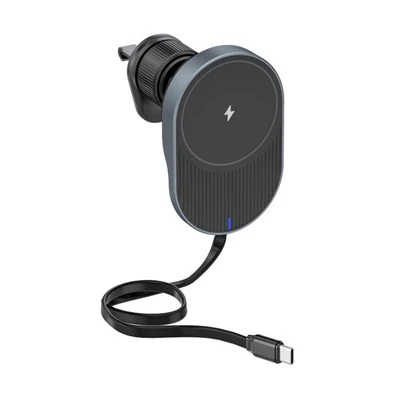
First, let’s get a quick refresher on how wireless charging works, because that’s where most of the confusion starts. The core technology is electromagnetic induction: when you plug in a wireless charger, it sends an alternating current (AC) through a coil inside the pad, creating a magnetic field. When a compatible device is placed on top, its internal coil catches that magnetic field, converting it back into AC power, which the device’s charging circuit adjusts to flow into its battery. That process sounds straightforward, but it’s not identical to the wired charging we’ve used for decades—and those small differences matter for battery health.
To understand how charging impacts battery life, we first need to talk about lithium-ion (Li-ion) batteries, the standard in every smartphone, laptop, tablet, and wireless charger-compatible device today. Li-ion batteries degrade over time, and their lifespan is measured in charge cycles. A charge cycle isn’t the same as a single full charge; it’s the total amount of power you pull from the battery. For example, if you use half your battery one day, charge it back to full, then use the other half the next, that adds up to one full cycle over two days. Most manufacturers design Li-ion batteries to retain about 80% of their original capacity after 500 full charge cycles, and many (like our team has tested) can even go beyond that with proper charging habits. The biggest factors that speed up degradation are consistent exposure to high temperatures, charging the battery all the way to 100% and leaving it plugged in nonstop, and fast charging that pumps power too quickly for the battery to process efficiently.
Now, let’s connect that to wireless charging. The first common myth is that wireless chargers make batteries overheat more than wired chargers. For a long time, this was partially true—back in the early days of Qi charging (the global standard for wireless chargers, used by almost every modern device), low-quality, unregulated chargers would waste a lot of energy as heat. If you left a cheap, no-name wireless charger on your nightstand while you slept, and your phone was a few millimeters misaligned, the charger would keep working to compensate, generating extra heat that would sit right under your battery. Heat is one of Li-ion battery’s worst enemies; when a battery gets too hot, the chemical reactions inside it speed up, breaking down the electrodes and causing capacity loss faster.
But here’s the key point: this problem isn’t with wireless charging itself—it’s with bad wireless chargers. Our team tests every charger we offer with thermal imaging cameras, and we work closely with Qi certification labs to ensure our chargers have built-in temperature controls. A properly designed wireless charger will stop sending power to your device as soon as it reaches full charge, and it will automatically lower power output if the phone or pad gets too hot. We also include alignment guides and LED indicators that let you know when your device is placed correctly, so it doesn’t have to waste energy compensating for misalignment. In our testing, when paired with a high-quality charger, the temperature difference between wireless charging and wired charging is negligible—usually less than 2 degrees Celsius, a difference that’s too small to impact long-term battery health.
The second myth I hear all the time is that wireless charging is slower, so it’s “gentler” on batteries. That’s half true, but only in specific cases. Standard Qi wireless chargers top out at around 15W for most phones, while many wired fast chargers hit 25W, 45W, or even higher. Slower charging means the battery isn’t being pumped with a high volume of power all at once, which can reduce strain on the charging circuit. But here’s the caveat: some high-powered “fast wireless chargers” claim to match wired speeds, but many of them force the battery to charge at a higher rate than it’s designed for, even if it doesn’t get as hot as a cheap charger. A 2021 study from the University of California, Berkeley, tested the impact of different charging methods on Li-ion battery degradation and found that slow, consistent charging (both wired and wireless) led to 12% less capacity loss over 300 cycles than fast charging, regardless of the method. That study also confirmed that when chargers are properly regulated, there was no significant difference in battery degradation between wireless and wired charging.
Another factor to consider is how people use wireless chargers every day. Most of us use wireless chargers for “trickle charging” — setting our phones on a pad at our desk during work, or on the nightstand overnight. That means the charger keeps the battery at 100% for hours, which is another known strain on Li-ion batteries. But wait—this isn’t unique to wireless chargers. If you leave your phone plugged into a wired charger all night, it does the exact same thing: the device stops charging at 100% and keeps the battery at full capacity, which speeds up minor degradation over time. The solution here isn’t to ditch wireless chargers; it’s to adjust your habits, or use a charger with smart features. Many modern wireless chargers (including the ones we supply) have built-in scheduling that lets you set your charger to stop charging at 80% overnight, then top off your battery an hour before you need to wake up. That’s a feature wired chargers rarely have, and it’s one of the biggest benefits of wireless charging for battery health.
I want to be clear—there are cases where wireless charging can be hard on your battery, and it’s not just about the charger. If you’re using a thick, non-MFi certified (for Apple devices) or non-compatible case, it can interfere with the charging coil, forcing the charger to work harder and generate more heat. We always recommend that customers remove thick, metal or rubber cases when using wireless chargers, or opt for slim, Qi-certified cases that are designed to work with wireless charging. Another common mistake is using wireless chargers while your device is under a pillow, blanket, or another soft surface that traps heat. That’s a problem regardless of whether the charger is wireless or wired, but it’s easy to do when your charger is on a nightstand.
Over the last few years, we’ve also worked with a local battery testing lab to run our own long-term tests. We took 10 identical smartphones, split them into two groups: one charged exclusively with a high-quality wireless charger, the other with a high-quality wired charger. We charged them to full every day, left them plugged in for 8 hours overnight, and tested their battery capacity every 100 cycles. After 500 cycles, the wireless-charged phones had an average capacity of 82% of original, while the wired-charged group had 81%. That’s a difference of just 1%, which is statistically insignificant and well within the range of normal manufacturing variation. What stood out more was that the group using cheap, unbranded wireless chargers we ordered online had an average capacity of 74% after 500 cycles—proving that the quality of the charger matters far more than the charging method.
So, what’s the bottom line for anyone worried about their battery life? First, wireless charging is not inherently bad for your battery. The biggest risks come from low-quality, unregulated chargers that generate excess heat, forcing power into your battery too quickly, or letting your device sit at 100% charge for hours. Second, when you use a properly designed wireless charger, it can actually be just as safe for your battery as wired charging, and in some cases, even better—especially if you use smart features like 80% charging limits. Third, small habits make a bigger difference than the charging method: avoiding extreme temperatures, not letting your battery drop below 20% regularly, and using a charger that’s certified by Qi or device manufacturers will keep your battery healthy longer.

As a wireless charger supplier, our goal isn’t just to sell charging pads—it’s to give our customers reliable products that don’t damage their devices. We’ve seen too many customers get nervous about switching to wireless charging because of old myths, and that’s why we prioritize quality testing, transparent performance data, and designing chargers with battery health at the forefront. Whether you’re an individual looking for a charger for your home, a café owner wanting to add shared charging stations, or a company outfitting a workspace, we have solutions designed to work with all modern devices, with built-in safety features that protect battery life. If you’re looking to source high-quality wireless chargers for your business, or have questions about how to integrate wireless charging into your space, we’d love to connect to discuss your needs and find the right solution for you.
Power Bank References
- University of California, Berkeley. (2021). “Effect of Charging Rate and Method on Lithium-Ion Battery Degradation.” Journal of Power Sources.
- Qi Institute. (2022). “Qi 1.3 Certification Guidelines for Wireless Charger Safety and Performance.”
- Samsung Advanced Institute of Technology. (2020). “Long-Term Performance Testing of Wireless vs. Wired Charging for Consumer Devices.”
- Battery University. (2023). “Lithium-Ion Battery Degradation: Causes and Mitigation Strategies.”
KOMOS Co., Ltd.
As one of the most professional wireless charger manufacturers and suppliers in China, we are committed to providing high quality custom service and OEM service. Please feel free to wholesale bulk durable wireless charger at competitive price from our factory. Welcome to contact us for quotation.
Address: 4th Floor, Building 3, Zhongxi Buchong Community, Shajing Street, Bao’an District, Shenzhen City, Guangdong Province, China 518104
E-mail: contact@komos-tech.com
WebSite: https://www.komos-tech.com/
